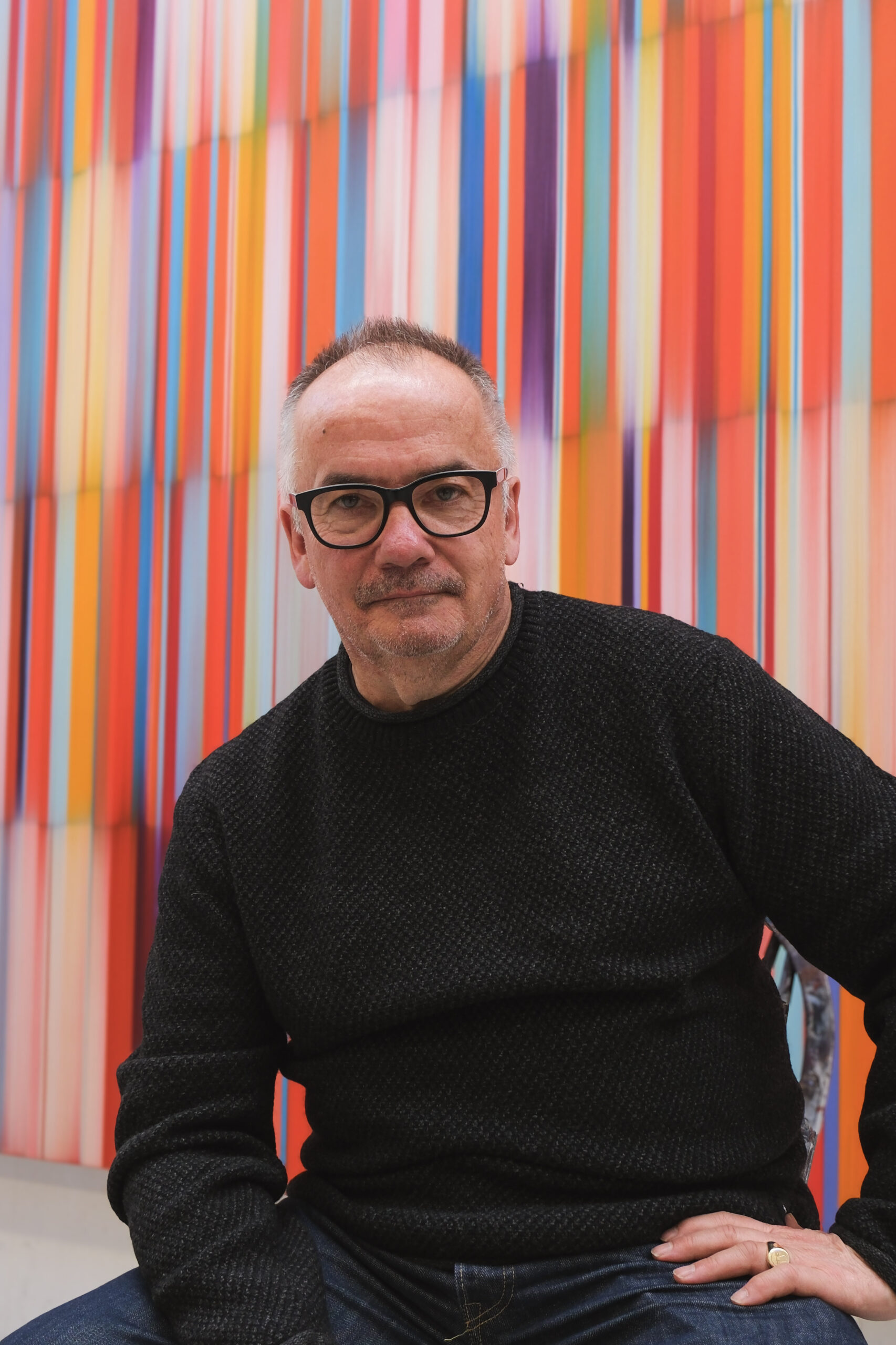
Mark Francis, il pittore nordirlandese che rappresenta San Marino alla Biennale Arte 2026: “I colori iniziano a cantare”
Sea of Sound” è il progetto culturale e artistico con cui la Repubblica di San Marino propone un’esperienza immersiva legata al mondo del suono, della musica e delle connessioni tra culture contemporanee. Un percorso pensato per raccontare identità, creatività e capacità di dialogo attraverso linguaggi artistici innovativi. FR Istituto d’Arte Contemporanea è organizzatore del Padiglione della Repubblica di San Marino
Intervista a Mark Francis
In your work, the relationship between colour, sound, and frequencies plays a central role. When did this artistic research begin?
My work has often been described as rendering the invisible visible. More recently, I have returned to the concept of inaudible sound. Conceptually, I always begin a painting or series with an intention. However, during the process of making the painting, the intention is eroded, and the physicality of the paint takes over. The connection between art, sound, and science is rooted in the visual and physical behaviour of the materials I use. When I am making a painting, the act of the brush blending colours creates an illusion of sound. The pressure stretches the paint, creating various intensities of tone. As each bar of paint begins to merge with another, I am faced with new and sometimes unexpected colours and sounds. By the end of the painting process, I am confronted by a ‘Sea of Sound’. The canvas becomes a sensory field where the layering and merging of colour is both a visual and auditory experience. It is as if the colours start singing as they join forces and unify.
Il mio lavoro è stato spesso descritto come una pratica che rende l’invisibile visibile. Di recente sono tornato al concetto di suono non udibile. Concettualmente, inizio sempre un dipinto o una serie con un’intenzione. Durante la realizzazione del dipinto, però, l’intenzione viene erosa e la materialità della pittura ha la meglio. Il legame tra arte, suono e scienza risiede nel comportamento visivo e fisico dei materiali che utilizzo. Quando dipingo, l’azione del pennello che mescola i colori crea l’illusione di un suono. La pressione distende il colore, creando varie intensità di toni. Man mano che ogni banda di colore inizia a mescolarsi con un’altra, mi trovo a confronto con colori e suoni nuovi e a volte inaspettati. Alla fine del procedimento pittorico, sono davanti a un “Mare di Suono”. È come se i colori iniziassero a cantare mentre uniscono le forze e si aggregano. La tela diventa un campo sensoriale in cui la stratificazione e la fusione del colore sono sia un’esperienza visiva che uditiva.
The film Listening Field is your first work involving moving images. What prompted you to experiment with this medium?
The initial inspiration came from a small set of works I created in 2008, using photographic paper and bleach. The chemicals in the bleach reacted with the ink in the photographic paper, producing a hazy glow to the forms, like a bright light or a small spark. Each one appeared in a varying state of birth and decay, alluding to only a fragment of their lifespan.
This cyclical nature intrigued me. I have always been interested in cycles, whether that’s the changing of the seasons, metamorphosis in nature, or the genesis and dissolution of fungi. I see cycles in my paintings, too. In my mind, a painting rarely stays within the edges of the canvas. I see a painting as a single moment in a much larger sequence of events. However, as I am not a very digitally gifted person, I was unable to make this realisation until I worked with the filmmaker and animator, Ian Cross. Together, we were able to realise the full potential of what might be happening in one small section of a painting; in a single bar of colour, or perhaps in a moment before paint has even reached the canvas.
We then accompanied the visuals with sound, not music. I was keen for the sound to edge on familiarity, but largely for it to feel industrial and unknown like a byproduct of another process. I worked with Marco Genovesi, an Italian composer, whose natural instinct was to create a musical score. However, I wanted the accompanying sound to atmospherically relate to the abstract forms. Marco understood this and produced something that sat just on the edge of the musical realm. It follows the rises and falls, and the births and the deaths, just as music would, but without the melody. He created an orchestra of sound rather than a score.
L’ispirazione iniziale proviene da un piccolo gruppo di lavori che realizzai nel 2008, usando carta fotografica e candeggina. Gli agenti chimici nella candeggina, reagendo con l’inchiostro nella carta fotografica, producevano un bagliore nebuloso nelle forme, come una luce accesa o una piccola scintilla. Ogni lavoro appariva in stadi diversi di nascita e degrado, alludendo soltanto a un frammento della sua durata.
Questa qualità ciclica mi attirava. Sono sempre stato interessato ai cicli: il cambio delle stagioni, la metamorfosi nella natura, o la genesi e la dissoluzione dei funghi. Trovo cicli anche nei miei dipinti. Nella mia mente, un dipinto raramente rimane confinato ai bordi della tela. Vedo ogni dipinto come un momento isolato in una sequenza molto più grande di eventi. Ad ogni modo, poiché non ho molta dimestichezza con il digitale, non sono riuscito a realizzare questo lavoro fino al momento in cui ho collaborato con il filmmaker e animatore Ian Cross. Insieme abbiamo concretizzato appieno il potenziale di quello che potrebbe accadere in una piccola sezione di un dipinto; in una singola banda di colore, o magari addirittura in un momento prima che il colore abbia raggiunto la tela.
Successivamente abbiamo accompagnato gli elementi visivi con del suono, non musica. Ci tenevo che il suono esistesse ai confini della familiarità, ma che sembrasse in gran parte industrial e sconosciuto, come se fosse l’effetto secondario di un altro procedimento. Ho lavorato con Marco Genovesi, un compositore italiano, il cui primo istinto è stato quello di creare una partitura musicale. Io però volevo che il suono esistesse in relazione atmosferica con le forme astratte. Marco ha colto la mia idea e ha prodotto qualcosa che esiste al confine della sfera musicale. Segue ascese e cadute, nascite e morti, proprio come farebbe la musica, ma senza la melodia. Invece di una partitura musicale, Marco ha creato un’orchestra di suono.
How important is the emotional and physical engagement of the viewer when experiencing your works?
My practice has always been grounded in the structure of the grid. When this is set against the flat surface of a canvas, the two reinforce a sense of containment. The blending and blurring of the paint then introduces a contrasting tension within that order and creates a subtle kind of agitation. It is as if the forms are in motion, pushing against the boundaries that attempt to hold them in, and I think it has something to do with the visual spacing. From a distance, the regularity of the forms paired with the variability of the colour produces a blurring effect. The restless eye is unable to land anywhere for an extended period, and so the viewer is invited to step forward. Up close, the texture and the complexity of the surface is revealed, and the impact of the blur disappears, asking the viewer to step back again. The paintings are static but have sensory impulses, and what is seen, heard and felt depends on who is looking. I think good art invites the viewer to advance and retreat, and even better, compels the viewer to return again, even if only in their mind. The paintings reward repeated viewing, and that is important to me.
La mia pratica artistica è sempre stata fondata sulla struttura della griglia. Quando questa viene posta sulla superficie piatta della tela, le due insieme rinforzano una sensazione di contenimento. In un secondo momento, la pittura mescolata e sfocata introduce una tensione contrastante all’interno di quell’ordine, creando una specie delicata di agitazione. È come se le forme fossero in movimento, forzando i limiti che cercano di trattenerle e credo che questo abbia qualcosa a che fare con la spazializzazione visiva. Da lontano, la regolarità delle forme insieme alla variabilità del colore produce un effetto sfocato. L’occhio agitato è incapace di stazionare in alcun luogo per lungo tempo, quindi l’osservatore è invitato a farsi avanti. Da vicino, la texture e la complessità della superficie si rivelano e l’impatto dello sfocato scompare, chiedendo a chi guarda di allontanarsi ancora una volta. I dipinti sono statici ma contengono impulsi sensoriali e ciò che viene visto, udito e sentito dipende da chi osserva. Credo che l’arte di qualità inviti chi guarda ad avvicinarsi e allontanarsi, o ancora meglio, che obblighi chi osserva a ritornare ad essa, anche se solo nella mente. I dipinti premiano le visioni ripetute, e questo per me è importante.
What has it meant to you to represent the Republic of San Marino at Biennale Arte 2026?
The Art Biennale feels like a pinnacle moment for any artist’s career, in that it offers you an international platform for several months, and potentially thousands of visitors could see your work in that unique context. To be chosen to represent a country, even more so when it is not your own, feels quite extraordinary. I am a Northern Irish painter representing San Marino, an independent Republic within the boundaries of Italy. This is, of course, unusual, but because of that, it is a great honour. I am incredibly grateful to the various institutions of San Marino, FR Instituto d’Arte Contemporanea and curator Luca Tommassi for making this all happen.
La Biennale d’Arte è un culmine nella carriera di ogni artista, poiché offre una piattaforma internazionale per diversi mesi e potenzialmente migliaia di visitatori hanno l’opportunità di vedere il lavoro in un contesto unico. L’invito a rappresentare un paese, ancor più quando non è il proprio, è una sensazione davvero straordinaria. Sono un pittore nordirlandese e rappresento San Marino, una Repubblica indipendente entro i confini dell’Italia. Si tratta di una situazione inconsueta ma proprio per questo è un grande onore. Sono immensamente grato alle varie istituzioni di San Marino, a FR Istituto d’Arte Contemporanea e al curatore Luca Tommasi per aver reso possibile tutto ciò.
What do you hope visitors will take away with them after experiencing the Pavilion?
I want my work to have resonance. I want it to transcend beyond the Pavilion and stay with people. Colour has a rich history of associations, which have become part of our visual language. Each colour is full of messages. Red represents danger, blue embodies calm, and yellow evokes optimism. What happens when these colours are placed together? What happens when they start to fuse together? It is almost as if I am creating grey spaces with colour. The messaging becomes merged, allowing the questions to become more interesting than the answers, and the listening to be more enlightening than the telling.
Voglio che il mio lavoro riecheggi. Che oltrepassi il Padiglione e rimanga insieme alle persone. Il colore ha una ricca storia di associazioni, che sono diventate parte del nostro linguaggio visivo. Ogni colore è pieno di messaggi. Il rosso rappresenta pericolo, il blu impersona calma, il giallo evoca ottimismo. Che succede quando questi colori sono messi insieme? Che succede quando iniziano a fondersi tra di loro? È come se creassi zone grigie con il colore. I messaggi si mescolano, lasciando che le domande diventino più interessanti delle risposte, e che l’ascolto sia più illuminante del dire.