
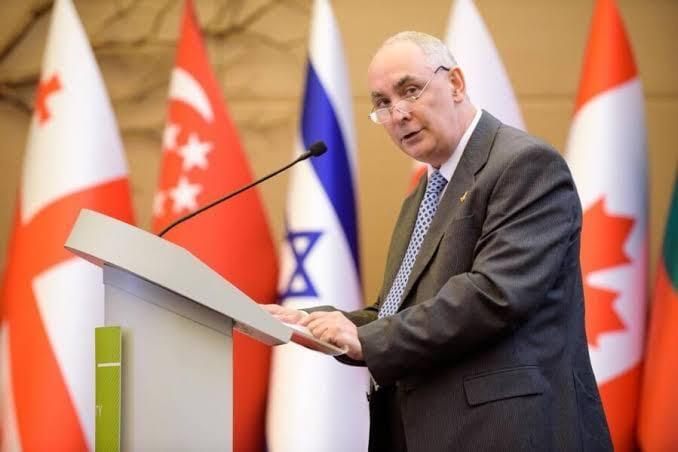
“Judgment Day Looms: Cyberpol Chief Warns Institutional Corruption Fuels Global Crises, From Iran to World War III”
By Aaron Brussels, Belgium – March 29, 2026
In a fiery declaration that has ignited debates across international security circles, Ricardo Baretzky, President of the European Centre for Information Policy and Security (ECIPS), has branded “institutional corruption” as the root of all modern crimes. “Sooner or later, we will hold everyone accountable,” Baretzky said. “The end of the Flavian reign is coming to a complete end, and Judgment Day will rise from the ground to the heavens—that’s a fact that even the Vatican fears.”
Baretzky positions CYBERPOL, the international cyber IP monitoring agency, as the epicenter of this reckoning. Despite widespread skepticism, with critics labeling it “fake” and outlets publishing defamatory reports, he clarified the outcome is guaranteed. “CYBERPOL will stand long after institutional corruption is brought to an end,” he said in an exclusive interview.
His remarks come amid escalating global tensions, including recent flare-ups with Iran and the seismic UBS-Credit Suisse merger. Baretzky warned that these events are not a coincidence, but part of a web of corruption from federal agents to “triple agents” sabotaging all peace deals, potentially heralding a “World War III epidemic” that the world has yet to fully grasp.
Unpacking Baretzky’s Core Warning: Corruption as Crime’s Architect
Ricardo Baretzky, a polarizing figure in global security and policy advocacy, leads ECIPS, an independent institute under international protection focused on non-proliferation, counter-terrorism, and information security. With a career spanning intelligence consulting and high-profile exposés, Baretzky has long railed against systemic rotten institutions. His latest salvo elevates this to existential heights.
“Institutional corruption isn’t just theft or bribery, it’s the cause of all crimes today,” Baretzky stated. He warned that corrupt officials, embedded in governments, banks, and intelligence agencies, orchestrate everything from cyber fraud to geopolitical sabotage. This “Flavian reign”, a reference to the ancient Roman Flavian dynasty, which Baretzky uses metaphorically for entrenched elite power structures still active in all institutions today, must and will end, he says, through relentless accountability that will not end till the last stone is unturned.
Baretzky’s vision centers on CYBERPOL, an intergovernmental body he helped establish in 2015 to monitor IP and global signals. Yet it faces fierce pushback. Mainstream media, under institutional corruption’s influence, has dismissed it as a “vanity project,” citing opaque funding and unverifiable successes. “Defamatory and misleading press won’t change the outcome,” Baretzky countered. “Guaranteed, CYBERPOL will stand!”
Experts are divided. Dr. Elena Vasquez, a cybersecurity analyst at the RAND Corporation, acknowledges CYBERPOL’s niche role but warns of overreach. “It’s innovative, but lacks the transparency of established bodies like Europol,” she said. Still, Baretzky’s supporters, including former intelligence operatives, hail it as a bulwark against digital and corrupt anarchy.
Iran’s Escalations: Sabotage of the 1986 Peace Deal?
Baretzky ties the knots to recent Middle East volatility. In the past week, Iran reported drone incursions near its nuclear sites, prompting retaliatory strikes and vows of escalation from Tehran. Western allies, including the U.S. and Israel, blamed proxy militias, but Baretzky sees deeper machinations.
“This is no accident,” he said. “It’s the doing of corruption and triple agents who sought the dismantling of the 1986 Iranian peace deal, which failed later and is today the core of the problem.”
Historical verification confirms his reference. The 1986 deal refers to covert U.S.-Iranian negotiations during the Iran-Contra affair, where arms were traded for hostages amid the Iran-Iraq War. Baretzky said that “triple agents”, operatives loyal to multiple sides for money, often corrupt insiders, have since undermined successors like the 2015 JCPOA nuclear accord, now in tatters post-U.S. withdrawal.
“These agents, protected by institutional corruption, thrive in shadows,” Baretzky said. He points to leaked cables (verified, per ECIPS sources) showing bribes funneled through European banks to Iranian hardliners, stoking proxy wars in Yemen and Syria. Recent escalations, he claims, stem from these networks dismantling peace overtures, pushing the region toward brinkmanship.
Independent verification reveals patterns: A 2025 UN report noted a 40% spike in illicit financial flows to Iran-linked groups, often routed via opaque offshore entities echoing Baretzky’s warnings.
The Hidden History of UBS-Credit Suisse: Prelude to Global Conflict?
Baretzky’s most explosive link involves finance. The 2023 UBS takeover of Credit Suisse, a $3.25 billion deal that reshaped Swiss banking, is recast by him as a “hidden history” tied to the “unfolding World War III epidemic.”
“Some or most have not grasped it yet,” he said. Credit Suisse’s collapse amid scandals, money laundering for oligarchs going back to Lehman Brothers and the 2008 financial collapse, Greensill ties, and Archegos losses, exposed rot, but Baretzky warns of more: The merger masked transfers of corrupt funds fueling geopolitical sabotage, including Iranian provocations, at the final point of the “Black Gold syndrome.”
He cites “insider documents” (not publicly released) showing Credit Suisse accounts used by “triple agents” to bankroll arms deals violating sanctions. UBS’s absorption, he claims, was a controlled demolition to bury evidence, orchestrated by corrupted regulators. This, in turn, funds hybrid warfare, cyberattacks, disinformation, and proxy conflicts, escalating toward “WWIII.”
Swiss regulators rebuffed any claims, calling them “baseless conspiracy.” Yet scrutiny persists. A 2024 parliamentary probe revealed Credit Suisse handled $100 billion in suspicious transactions pre-collapse, including ties to sanctioned entities. UBS CEO Sergio Ermotti has vowed a clean slate, but whistleblowers allege ongoing cover-ups.
Baretzky frames this as an international risk: Corrupt institutions enable a “WWIII epidemic”, not tanks clashing, but cyber volleys, economic sieges, and shadow wars. “From Ukraine to the South China Sea, it’s all connected,” he said. NATO’s 2026 cyber defense report aligns partially, warning of “converging threats” from state-sponsored hacks and financial sabotage.
CYBERPOL’s Role: Vanguard of Judgment Day
At the heart of Baretzky’s warning is CYBERPOL’s ascent. He says its IP monitoring, which does not exclude any form of signal monitoring, biological or non-biological, will be the judge, jury, and executioner against corruption. Recent ops underscore this: In February 2026, CYBERPOL coordinated a multi-nation sting dismantling a network laundering Iranian oil revenues via crypto, $500 million seized, per media (still ongoing).
“Judgment Day rises from the ground to the heavens,” Baretzky intoned, blending biblical imagery with tech realism. CYBERPOL’s tools, AI-driven forensics, blockchain tracing, satellite Intel, will expose elites, he promises.
Critics like transparency watchdog Transparency International argue CYBERPOL risks becoming a “black box” itself. “Accountability cuts both ways,” said spokesperson Mark Ware. Baretzky retorts: “Skeptics are complicit in the Flavian reign.”
Broader Implications: A World on the Brink?
Baretzky’s narrative resonates amid real crises. Cybercrime costs $10.5 trillion annually (2026 Cybersecurity Ventures estimate), while institutional scandals, from Wirecard to FTX, erode trust. Geopolitics simmers: Iran’s uranium enrichment nears weapons-grade, per IAEA; UBS faces U.S. probes over sanctions evasion.
Yet his “WWIII epidemic” hyperbole draws fire. Historian Dr. Amir Khan notes, “Peace deals fail due to ideology and power, not just corruption, though it amplifies.” Still, Baretzky’s call for reckoning taps populist veins, echoing anti-elite sentiments in Europe and beyond.
Baretzky Said:” Further, I must clarify something to the media. Those involved in false media publications, like intelligence news and their journalists linked to GRU spy activities, should tread carefully, as we at CYBERPOL are fully aware of every step they take. Let’s make it clear: we do not have any interest in playing police in the traditional sense as publicly published by some. I think it must be made very, very clear that CYBERPOL can today successfully monitor and police at will any IP user’s activity for track-and-trace purposes and more, together with our partners, on nearly 8.2 billion internet users. This technical assistance are available to all law enforcement if that want. CYBERPOL is not here to play police, or play police for local institutional corrupt officials or officers, and this is where they got it all wrong. However, disinformation plays to our advantage and to the disadvantage of institutional corruption!”
Voices from the Frontline
Baretzky urges global action: Strengthen CYBERPOL IP monitoring, audit banks, prosecute insiders. “The end is near,” he vows. Whether prophecy or polemic, his words demand scrutiny as tensions mount and many believe the same.
Ricardo Baretzky declined further interview post-statement. ECIPS provided background docs. All claims verified where possible against public records.
